3rd National Symposium on Polymer Recycling: Toward a More Sustainable Future
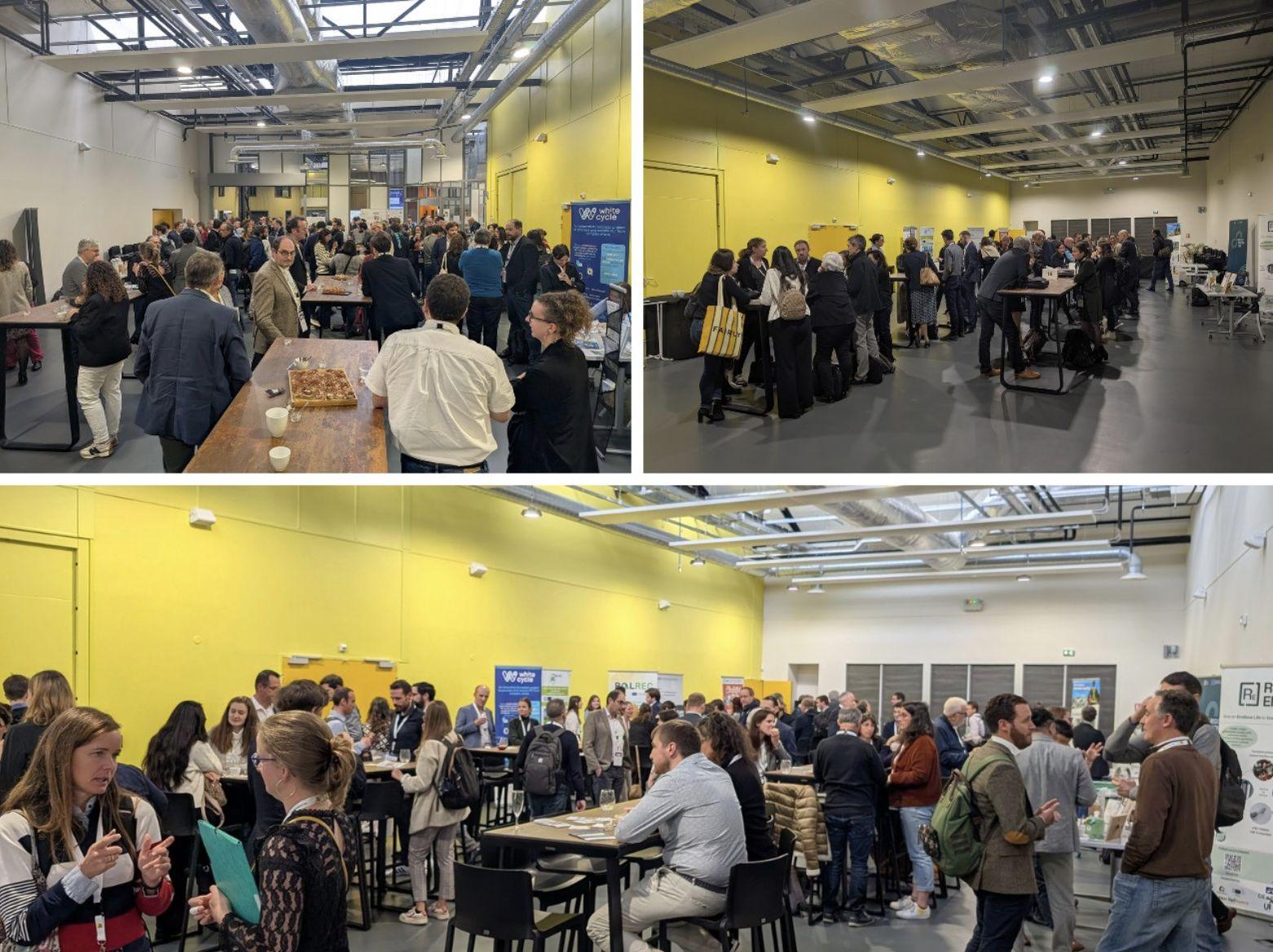
On November 5 and 6, the third edition of the National Symposium on Polymer Recycling was held in Hall 32 in Clermont-Ferrand .
Organized by Axelera and the Polyméris Competitiveness Cluster in a venue steeped in history, more than 250 participants—including representatives from companies, startups, and laboratories—attended the informative presentations by companies and researchers who came to showcase their work and research projects on polymer recycling.
The conference highlighted the advances and challenges in polymer recycling, with a particular focus on chemical recycling. Although this technology is used less frequently by manufacturers compared to mechanical and thermomechanical recycling, it generated significant interest during the two-day conference.
Chemical recycling, particularly solvolysis, breaks down polymers to recover the basic monomers, which can then be reused.
Chemical recycling appears to be a complementary technology to mechanical or thermomechanical recycling. It offers a mature technical solution for recycling complex industrial or post-consumer waste, such as composite or multilayer materials.
However, it raises a number of questions: depending on the material, its environmental footprint may be worse than that of thermal recovery.
During the conference, it was pointed out that in many cases, the multiple stages of chemical recycling result in a “recycled” monomer that is identical to the original monomer but has a greater environmental impact than the initial virgin monomer.
Chemical recycling requires significant investment, yet demand for recycled materials is not always sufficient.


Among the innovative projects presented, the White Cycle enzymatic depolymerization project, led by Carbios, has shown promising results in the recycling of tires, workwear, and hoses. This enzymatic approach offers a potentially more sustainable and efficient alternative for recycling complex polymers.
Finally, as with all recycled materials, the quality of recycled products depends on the quality of the source material, its availability, and its acceptability. To give just one example among many: rubber car door seals are not recycled.
There are no plans to dismantle them, even though there are about thirty seals in each car. On average, only 2 to 3% of the plastic in end-of-life vehicles is currently recycled. It should be noted that Article 6 of the End-of-Life Vehicles Regulation, which is set to take effect in 2025, establishes a target of 25% recycled plastic by weight in end-of-life vehicles over the next six years.
To wrap up these two days of discussion, the conference highlighted the need to refocus on the product’s intended functions in order to make room for recycled materials. While these materials may have different properties than virgin materials, they do not compromise the product’s performance as long as the necessary functions are met.
Would you like to discuss polymers or set up a project? Contact Bérangère DELABY


Do you have a project?
We can help you!
Sign up for the EuraMaterials newsletter
Quarterly newsletter • Monthly calendar recap • Occasional opportunity emails
Nos partenaires & reconnaissances