Combating false environmental claims on packaging

A study commissioned by the European Commission highlights significant concerns regarding environmental claims on product packaging. It reveals that more than half of these claims (53%) are vague, misleading, or unfounded, and that 40% are not supported by tangible evidence. In response to these findings, the European Union is considering strict measures to restore consumer confidence.
It plans to ban unproven generic environmental claims and assertions of carbon neutrality, reduction, or positive impact without proof of offsetting those emissions. Additionally, sustainability labels without approved certification will be banned. To achieve these goals, two directives are proposed: the first aims to combat greenwashing by targeting new deceptive commercial practices, while the second, the “Green Claims” Directive, focuses on the substantiation and transparent communication of environmental claims.
These directives will need to be incorporated into the national legislation of EU member states to harmonize European regulations. In France, the Anti-Waste and Circular Economy Laws, supported by the Climate and Resilience Law, currently constitute the main legal framework governing environmental claims.
Definition of an environmental claim
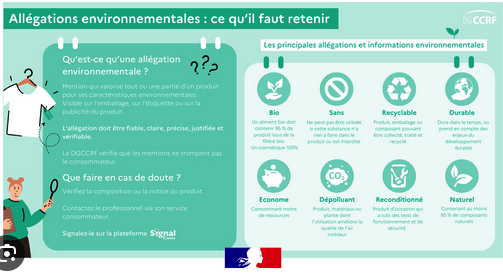
An environmental claim refers to the ecological characteristics of a product or its packaging, with the aim of highlighting them. It may appear on the product’s packaging, label, or advertising. It is important to distinguish these claims from simple information that relates solely to the ecological qualities of products, or to environmental information concerning them. Any claim made must relate to a significant ecological aspect and must not result in the displacement of pollution or additional environmental impacts
Legal Framework in France
European legislation on environmental protection and transparency of consumer information has seen significant progress in recent years, with the adoption of two major laws: the Anti-Waste and Circular Economy Act (AGEC) of February 2020 and the Climate and Resilience Act of August 2021.
The Anti-Waste and Circular Economy Act (AGEC) introduced measures aimed at improving environmental information for consumers and imposing stricter regulations on the use of environmental claims. In particular, this law established provisions such as the repairability index, information on endocrine disruptors, and the simplification of waste sorting procedures. Furthermore, it has banned claims considered to be overly broad, with the aim of preventing any confusion or deception of consumers.
The Climate and Resilience Act, for its part, consolidated and expanded upon the measures initiated by the AGEC. In particular, it introduced an environmental labeling system, enabling consumers to make informed choices by favoring products with reduced environmental impacts. Furthermore, this law provided for the creation of a product sustainability index to replace the repairability index, as well as a ban on “greenwashing” as a deceptive commercial practice, accompanied by stricter penalties.
Alongside these regulations, the issue of environmental labels also arises. These labels, which are intended to guide consumers toward more environmentally friendly products, can vary in terms of reliability and certification. Some labels are self-declared by producers or distributors, while others are verified or certified by independent third-party organizations. Labels compliant with ISO 14024, also known as Type 1 labels or Ecolabels, are considered the most reliable, ensuring rigorous environmental criteria throughout the product’s entire life cycle.
The new directives to be proposed by the European Commission:
New misleading commercial practices:
The Directive on Misleading Commercial Practices would expand the existing list by addingnew commercial practices deemed unfair underall circumstances.
In particular, it would prohibit anysustainability labelthat is notbasedon acertification systemor that has not been established by public authorities.
The directivewould prohibit environmental claims that do not:
- backedby clear, objective, publicly available, and verifiable commitments and goals, and,
- set out in adetailed and realistic implementation plan(outlining, in particular, how these commitments and objectives will be achieved and allocating resources for that purpose).
- verified by an independent third-party expert who is free from any conflict of interest, has experience and expertise in the field of the environment, and is capable of regularly monitoring progress toward the commitments and objectives of the implementation plan.
Guidelineon thesubstantiation and communication of environmental claims.
In particular, this draft directive specifically provides that companies should:
- Substantiate explicit environmental claims with detailed evidence that meets afairly extensive “set of criteria”(as detailed in Article 3 of the draft),which includes scientific evidence
- Submitthe justification and disclosure of the environmental claimand environmental labels to an independent, accredited third-party verifier forverification and approvalprior to their use, with the verifier issuinga certificate of compliance.
- Provide information supporting the claim along with the claim itself, such as a web link, a QR code, or an equivalent.
Also note the provisions of the new Packaging and Packaging Waste Regulation (PPWR) specifically regarding packaging:
No later than42 monthsafter the regulation takes effect, packaging must bear alabel clearly indicating the materials from which it is made. While this measure does not apply to transport packaging, it does apply to e-commerce packaging.
No later than48 monthsafter the regulation takes effect, packaging designed for reuse mustbear a label indicating reuse options, as well as aclearly visible and indelibleQR code(or other digital medium) to provide additional information on reuse.
Publications:
– Practical Guide to Environmental Claims by the CNC (National Consumer Council)
– Environmental Claims on Product Packaging: Opinions and Recommendations of the CNE – June 2023 Edition



Do you have a project?
We can help you!
Sign up for the EuraMaterials newsletter
Quarterly newsletter • Monthly calendar recap • Occasional opportunity emails
Nos partenaires & reconnaissances